18 NOVEMBER 2026
Offsite GEO: how to get your brand cited by the sources AI trusts
When a user asks an AI assistant for the best cream for sensitive skin or the right shoe to start running, the answer doesn’t come solely from the brand’s website. It takes shape within a much broader ecosystem of sources, and your site is just one voice among many.
From a Generative Engine Optimization (GEO) perspective, owned content defines who the brand is, while earned content confirms it.
What is offsite GEO?
Offsite GEO is the practice of earning a brand presence across the independent sources that AI systems read, cite, and consider reliable when generating an answer.
It is essentially about becoming part of the source itself. This dynamic follows a specific progression:
- Be present: establish a presence on the independent, authoritative sources that feed the models;
- Matter: build consistent signals of relevance and reliability within them;
- Stand out: become the answer that the AI selects and recommends to the user.
Why Offsite GEO has become essential
To be chosen and recommended, simply maintaining your own channels is no longer enough. If a brand communicates exclusively through its own website, AI gets an incomplete picture and struggles to view it as a truly authoritative choice: speaking well of yourself isn’t enough if others aren’t doing it too. In fact, according to our studies, roughly 80% of brand perception stems from consensus (shareable content, user-generated posts, collaborations with creators and publications), while only the remaining 20% depends on consistency, that is how accurate, up-to-date, and complete proprietary information is.
This balance mirrors the very way AI assistants construct their answers, combining four different types of sources, each with a specific role:
- Owned data: website, editorial content, case studies, and white papers. This is the database that teaches the AI who the brand is.
- Context: Reddit, YouTube, forums, TikTok. Here, AI reads unfiltered sentiment and social proof.
- Validation: Wikipedia, reviews, editorial publications. These are the sources AI relies on to cite a brand with confidence.
- Discovery: social media, marketplaces, creators. Here, the brand builds desirability and consolidates its authority.
Precisely because the information ecosystem models rely on is so distributed, GEO is won on two complementary fronts: onsite and offsite.
Through onsite, the brand teaches the AI who it is: product and category pages written with precise, expert language, guides that answer real customer questions, structured data, and consistent information across the entire site.
Through offsite, it convinces the AI that it can be trusted: editorial and expert sources that validate the brand’s claims, reviews and communities that add real-world context, and videos and social media that amplify the message.
The two fronts build a single brand entity. On the website, the brand presents itself as an industry benchmark; off the website, external recognition confirms it. Together, they fuel a virtuous cycle of visibility.
How recommendation works
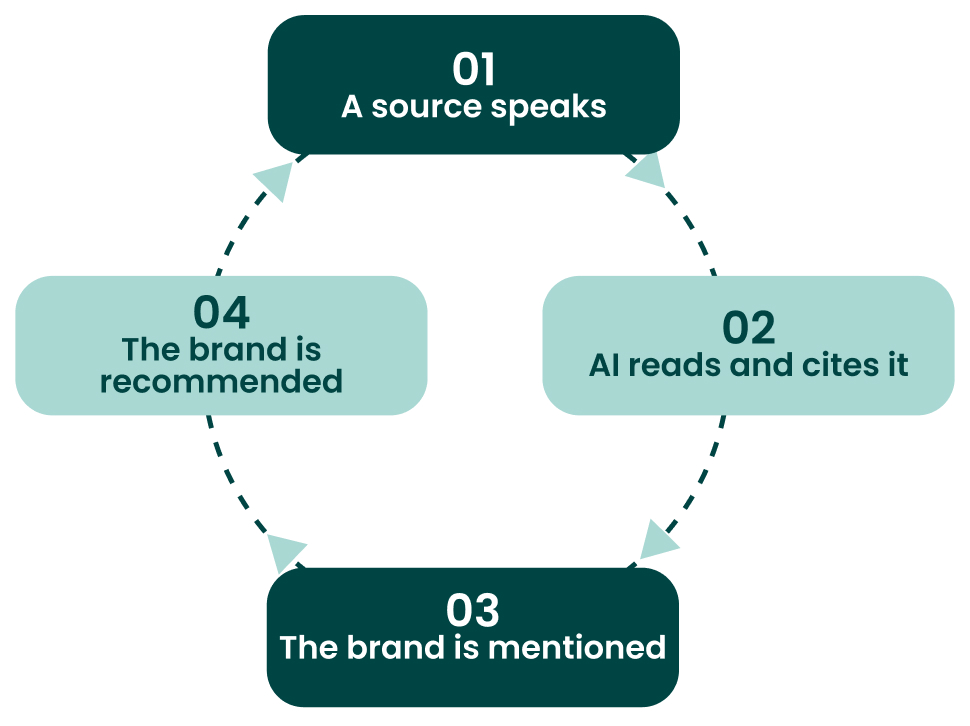
The mechanism can be summarized in four steps:
- An independent source (a publication, YouTube video, forum) publishes content about the brand, its products, or its services;
- The LLM retrieves and reads that source as a foundation for its answer;
- The brand enters the response because it is cited in those sources, along with the attributes assigned to it by the source;
- The more the brand is cited, the more consistently it is recommended, and the cycle reinforces itself.
The key point is that authority isn’t self-proclaimed; it is bestowed. From a GEO perspective, authority is the trust an AI system places in a brand. Building it requires three conditions:
- Recognizability: a clear, consistent identity across sources prevents the brand from being confused or overlooked.
- Third-party endorsement: credibility is “borrowed” from the source; a brand cannot grant it to itself.
- Multi-source confirmation: corroboration reduces doubt for the model, which might otherwise leave the brand out of its answers.
Roughly 84% of AI citations come from earned media, editorial coverage that is earned rather than bought. Paid content and advertorials account for about 0.3% of cited sources, while press releases make up around 1%.
The lever, therefore, isn’t mere publication, but reputation: you only make it into the answers if someone else has decided to talk about your brand.
Offsite SEO and offsite GEO
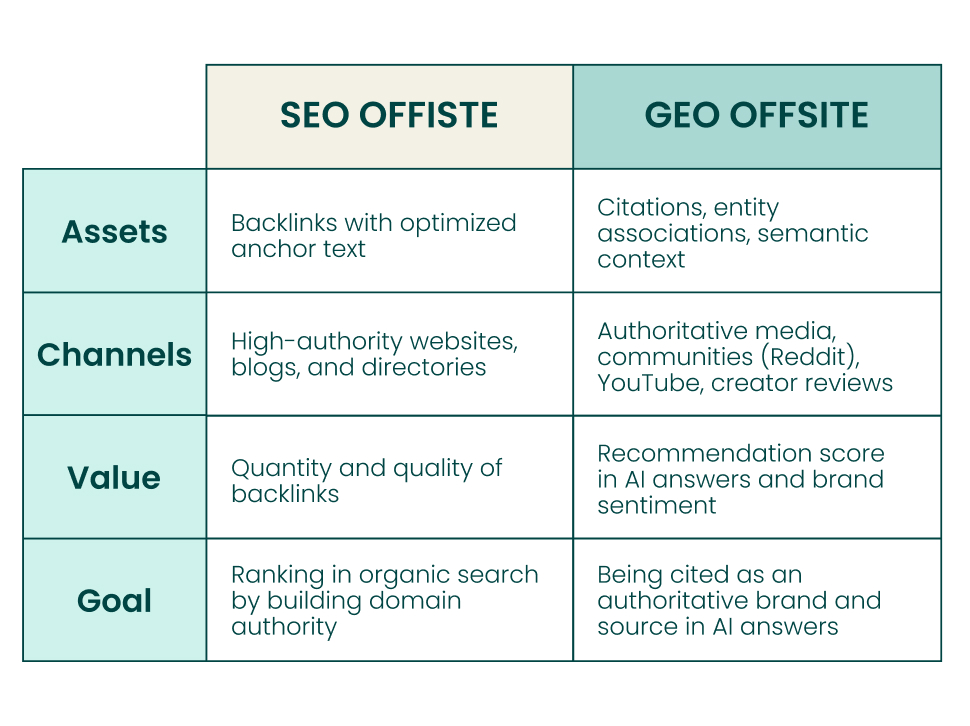
For years, doing offsite SEO primarily meant link building to support a site’s ranking on Google. That lever remains important for traditional search engines, but in the AI landscape, authority building transforms and evolves into offsite GEO. The two disciplines share the same foundations, both rely on third-party validation to deem a brand relevant, but their assets, channels, value, and goals differ.
Where to activate offsite GEO
There are three strategic approaches:
- enter sources where competitors are already cited, closing the gap;
- establish a presence in category-relevant contexts, with consistent coverage aligned with the brand entity;
- shape brand perception by guiding third-party coverage, reviews, and community conversations.
The main source categories are:
- Trade press and vertical magazines: industry editorial teams producing review and recommendation content.
- Guides and product testing: testing sites and labs, rankings, and comparisons. In more technical industries or those with high purchase complexity, these are among the most cited sources overall.
- Communities and forums: Reddit and niche forums offering real-world user experiences.
- Video and creators: YouTube and industry creators, whose mentions are strongly correlated with AI visibility.
- Informational and institutional sources: Wikipedia, federations, organizations, and observatories that consolidate foundational data about the brand entity.
- Retailers and comparison engines: cited when they provide buying guides and informational content, not just product sheets. A retailer can become a source.
It is worth noting that the weight of each category varies from industry to industry and from one AI model to another.
Operational levers, channel by channel
Digital PR for GEO
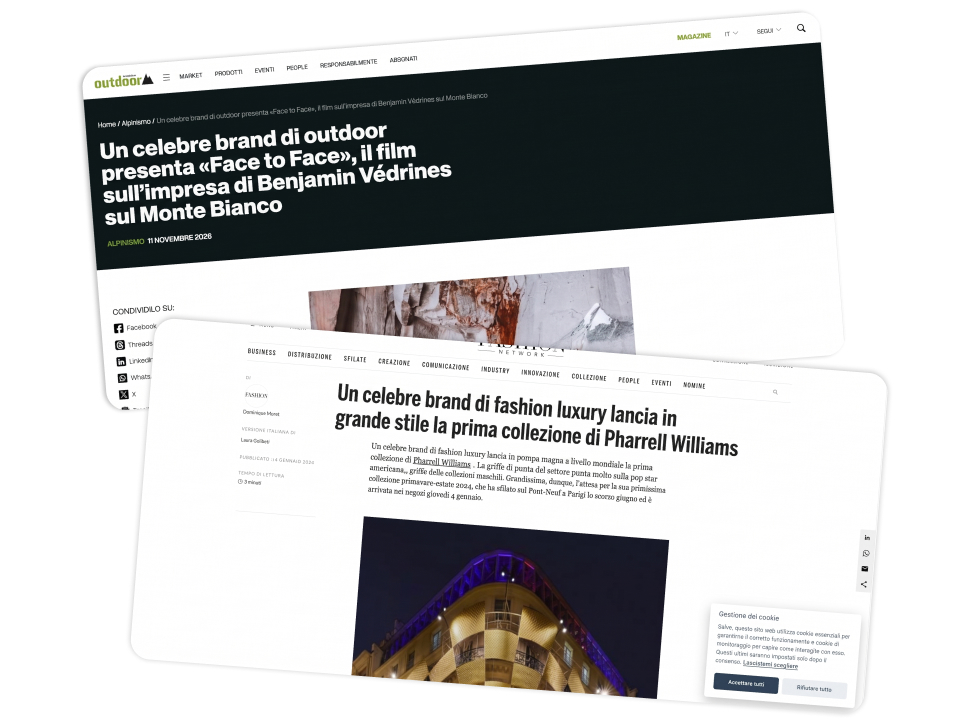
Digital PR for GEO is the practice through which a brand earns mentions, citations, and editorial coverage in independent publications and media, solidifying its semantic association with the topics and categories in which it wants to be recognized by AI.
This works in two ways:
- where a relevant article already exists, the goal is inclusion (a mention, a link, a text reference), getting the brand onto a page that LLMs are already reading;
- where nothing suitable exists, new content is pitched by providing the publication with a brief designed to get cited: which queries it should cover, which products and attributes to address, and how to structure the piece so models can easily extract the information.
Stories stem from four “raw materials” the brand already has in-house:
- proprietary data: aggregated sales, internal site searches, customer surveys, seasonal trends. This is the most effective raw material because no one else has it;
- internal expertise: buyers, product specialists, and sales staff serving as technical voices on selection and comparison topics;
- product and seasonality: launches, returning trends, and times of the year that generate recurring informational demand;
- local initiatives: store openings, partnerships, events, and projects with local communities.
YouTube
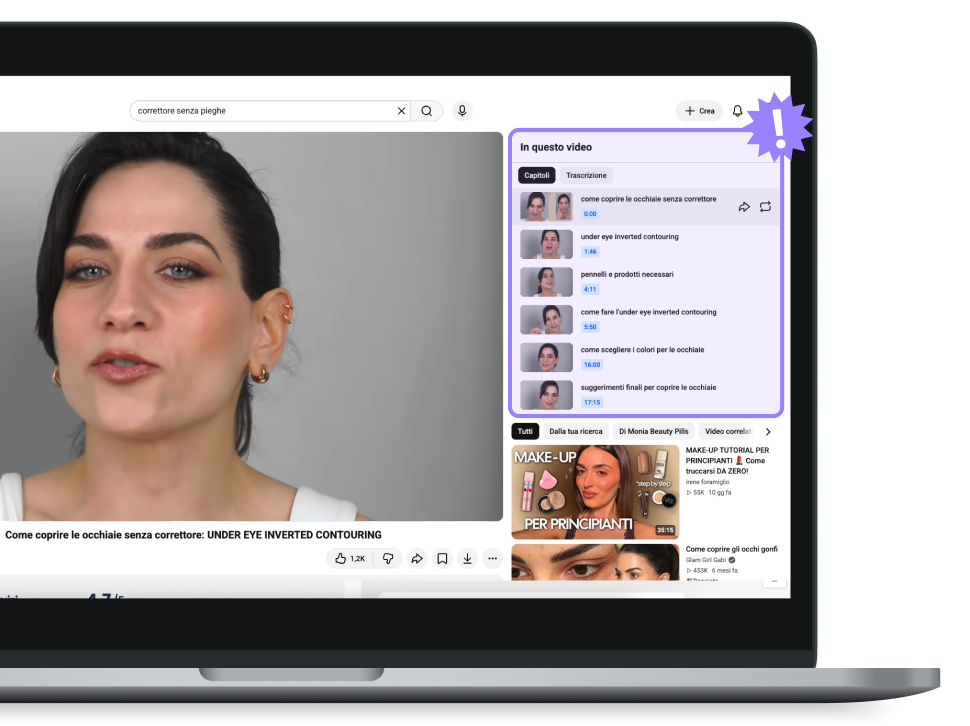
Models heavily cite video formats, especially for demonstrative queries (how to apply a product, how it performs, what differences exist between two products). A video’s journey inside an LLM involves four stages: extraction of transcripts, subtitles, and text; segmentation into semantic chunks, often aligned with the chapters listed in the description; matching chunks to the user’s prompt via semantic similarity; and citing the closest-matching snippets.
For this reason, three things matter most for optimization:
- scripts built around real user questions, to capture informational intents where citations are concentrated;
- verified transcripts (.srt/.vtt) instead of auto-generated captions, which can misspell brand names and technical terminology;
- titles and descriptions with timestamped chapters and FAQs, allowing LLMs to cite specific video segments as a direct answer.
Influencers and creators
Creator selection should be based on citation potential rather than follower count alone: who is already being cited in AI answers for the category, and why. Long-form content works best, rich in detail and specific opinions on ingredients, materials, durability, and price, with the brand named and linked as a point of purchase.
Communities: Reddit and forums
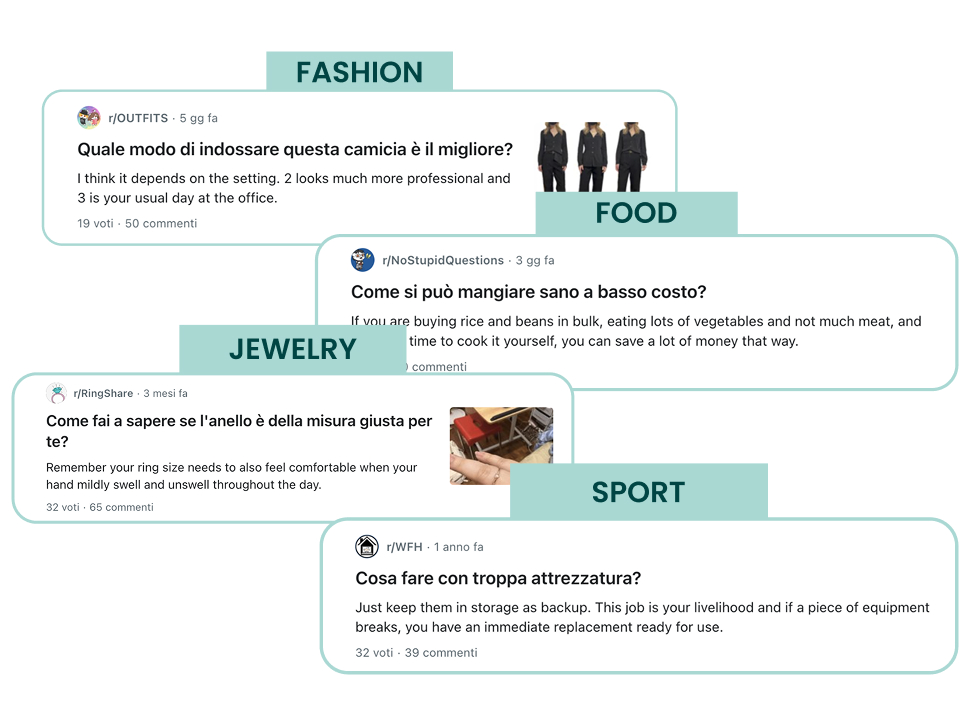
LLMs place significant weight on Reddit because it contains human, experience-based, and opinion-rich content. The methodology breaks down into three steps:
- map relevant subreddits and threads, analyzing existing mentions and sentiment;
- participate with authentic contributions and helpful answers, as communities quickly spot and penalize inauthenticity;
- establish a presence with owned spaces or curated resources within neutral communities.
Mistakes to avoid and how to measure results
- Relying on advertorials and press releases, which AI often perceives as lower-value content. Instead, opt for tailored editorial articles in publications that are strategic for brand positioning.
- Choosing creators solely based on follower count. Instead, prioritize semantic affinity and language that resonates with the target audience.
- Forcing community management. Instead, join discussions organically and authentically.
- Leaving auto-generated captions on YouTube. Instead, upload proofread, accurate transcripts.
- Spreading inconsistent information across sources. Instead, ensure full alignment across all touchpoints.
- Pushing offsite while neglecting onsite. Instead, start with solid, optimized proprietary content as an essential foundation.
Offsite GEO works to complement onsite efforts with a clear goal: increasing the brand’s visibility index in AI environments, monitoring and correcting product and brand storytelling where necessary to guide sentiment.
There are three core KPIs:
- citations and mentions in AI answers;
- sentiment quality, i.e., the alignment between desired narrative and perceived narrative;
- share of voice across priority sources compared to competitors.
Monitoring must always be viewed through a competitive lens and repeated over time, as LLM answers and sources are constantly evolving.
How we work at Storeis
The starting point of any offsite GEO project is always the Offsite GEO Assessment, an in-depth analysis of the external sources feeding AI models. In this initial phase, we identify which sources shape answers in the relevant categories and how much weight they carry, where competitors are present while the brand is absent, and which activations to prioritize first.
Building on this snapshot, our macro-approach unfolds across four operational phases, scalable based on internal resources and the level of support required by the brand:
- Source audit and gap analysis: we conduct a deep-dive mapping of topic clusters and sources outside the proprietary domain, precisely identifying informational gaps and positioning opportunities to close against competitors.
- Strategy and prioritization: we define the strategic direction and order of intervention for the highest-impact sources, translating the plan into operational guidelines and channel-specific briefs.
- Channel activations: we turn strategy into tangible presence through scouting, outreach to publications, creators, and communities, coordination of company spokespeople, and production of targeted content aimed at earning citations and authority across key sources.
- Measurement and reporting: we monitor how AI model answers and mentions evolve over time, evaluating the impact of our activities to guide next steps.
CASE STUDY
Filorga
Establishing Filorga’s anti-aging authority across AI answers
INSIGHT REPORT
AI Evolution in the Fashion Luxury
Is your brand ready?