22 OCTOBER 2026
Is your store ready for Agentic Commerce?
AI assistants are introducing new touchpoints throughout the online buyer’s journey. Their arrival is fundamentally reshaping search behavior: users can now describe a need, evaluate alternatives and, in enabled environments, complete a purchase directly through an assistant.
This paradigm shift demands a strategic rethink. Before tackling technical implementation, one core principle must be understood: to be bought by an autonomous agent, you must first be found, understood, and recommended.
New native checkout protocols represent the final mile of the transaction, but they will never be triggered if the AI excludes your product catalog upstream. The key to scaling in this new ecosystem no longer lies in basic catalog maintenance, but in a radical evolution of the Product Feed and its AI readiness.
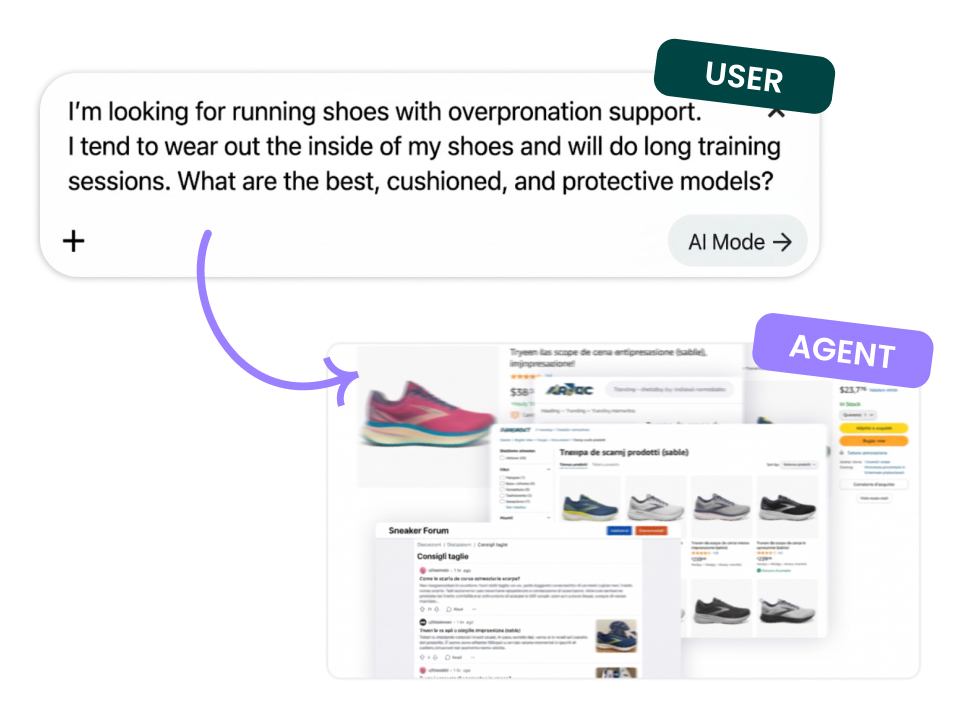
What is Agentic Commerce and where does it come from?
Agentic commerce is poised to become the next standard in online retail, shifting the shopping experience away from traditional ecommerce websites and onto autonomous AI agents. These agents understand natural language intent, evaluate context, and complete purchases directly within enabled LLM or AI Chat interfaces.
This marks a shift from an interaction-based shopping experience, where customers manually browse catalogs, apply filters, and search across websites, to an outcome-based model, where customers express an intent and the AI agent manages the entire operational lifecycle on their behalf.
The customer journey will unfold across three distinct, potentially complementary phases:
- Traditional Ecommerce: Keyword searches driving traffic to brand websites.
- Generative AI: Conversational assistants answering questions without executing transactional tasks.
- Agentic AI: Outcome-driven systems capable of managing cart contents, applying discount codes, and securely completing checkout.
UCP: the universal protocol powering Agentic Commerce
Co-developed by Google and Shopify and backed by major global digital players (including Amazon, Meta, Microsoft, Stripe, Visa, Mastercard, Etsy, Target, and Walmart), the Universal Commerce Protocol (UCP) is the open standard making agentic commerce possible.
Its primary function is to define a common, programmatic language between AI agents and merchant backend systems, covering the complete end-to-end purchasing journey: product discovery, cart management, checkout, and post-purchase support.
The protocol natively integrates with established industry standards such as A2A (Agent-to-Agent Protocol), AP2 (Agent Payments Protocol), and MCP (Model Context Protocol).
Through UCP, merchants can embed an instant buy button directly inside advanced conversational interfaces, including AI Mode in Google Search, Gemini, ChatGPT, and Microsoft Copilot.
Currently, the UCP program and its native integration hub in Google Merchant Center are rolling out progressively in the US for select merchants and partners. Launches in Canada and Australia are planned for next year (2027), while official rollout dates for the European market have not yet been announced.
The new search landscape: AI, LLMs and Generative Engine Optimization (GEO)
Search behavior is changing fundamentally. In AI interfaces, user prompts are three times longer than traditional search queries.
Furthermore, users are expressing complex needs that bypass standard product data matrices (title, description, material, color, etc.). The underlying product attributes haven’t necessarily multiplied; what has changed is how consumers find products.
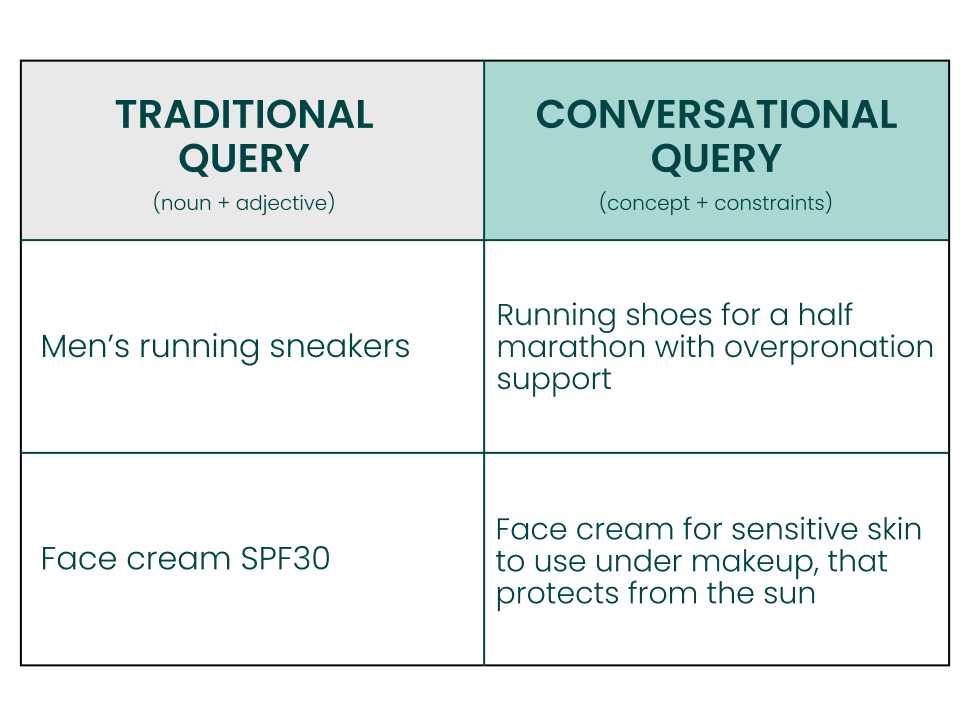
In this environment, matching is no longer a matter of keyword density—it is an exercise in reasoning. The LLM must process multiple variables simultaneously (price, performance, compatibility) while evaluating subjective criteria, nuanced claims, and synonyms to infer details no brand states explicitly.
Phrases like “overpronation support” or “suitable under makeup” rarely exist as standard feed attributes. To answer these prompts, LLMs rely on user reviews, community forums, and Reddit; indirect technical specs (construction, formulation, recommendations); and implicit signals like images, measurements, and brand reputation.
This shifts the requirements: brands need new layers of information and a substantial upgrade in product data to supply incremental answers and stay visible in evolving customer journeys.
Consequently, Generative Engine Optimization (GEO) has become critical. It forces brands to bridge information gaps by turning “flat” product data into context-rich content designed to satisfy long-tail, conversational queries.
The evolution of product feeds: Conversational Attributes
For the past fifteen years, the Google Merchant Center product feed served as the baseline for ecommerce catalogs, repurposed across social campaigns, marketplaces, price comparison engines, and retargeting. With the rise of Agentic Commerce, it is no longer a static list of prices and stock levels; it has evolved into the primary knowledge layer feeding intelligent decision-making agents.
The biggest differentiation opportunity lies in providing product attributes that AI models cannot reliably infer or extract from existing standard data. When authoritative, structured data is missing, LLMs tend to “guess”, for example, arbitrarily inferring whether a garment is eco-friendly. Supplying enriched, precise product data significantly reduces misinformation and hallucinations, ensuring accurate recommendations and preventing post-purchase returns or customer dissatisfaction.
Data enrichment also dramatically increases the likelihood of a product being selected and surfaced by AI engines as a top recommendation. Structured data is a core component of GEO and a key factor in ranking within Google’s hybrid SERPs. Furthermore, embedding these attributes into conversational feeds powers both emerging ad formats (such as OpenAI Ads) and established revenue channels (like Google Shopping and Performance Max).
Finally, delivering hyper-detailed, proprietary data creates a defensive moat around search visibility. This environment strongly favors structured brands and original manufacturers, granting them a decisive edge over multi-brand resellers and resource-constrained competitors who face rising costs and complexity when upgrading their product data to match modern AI standards.
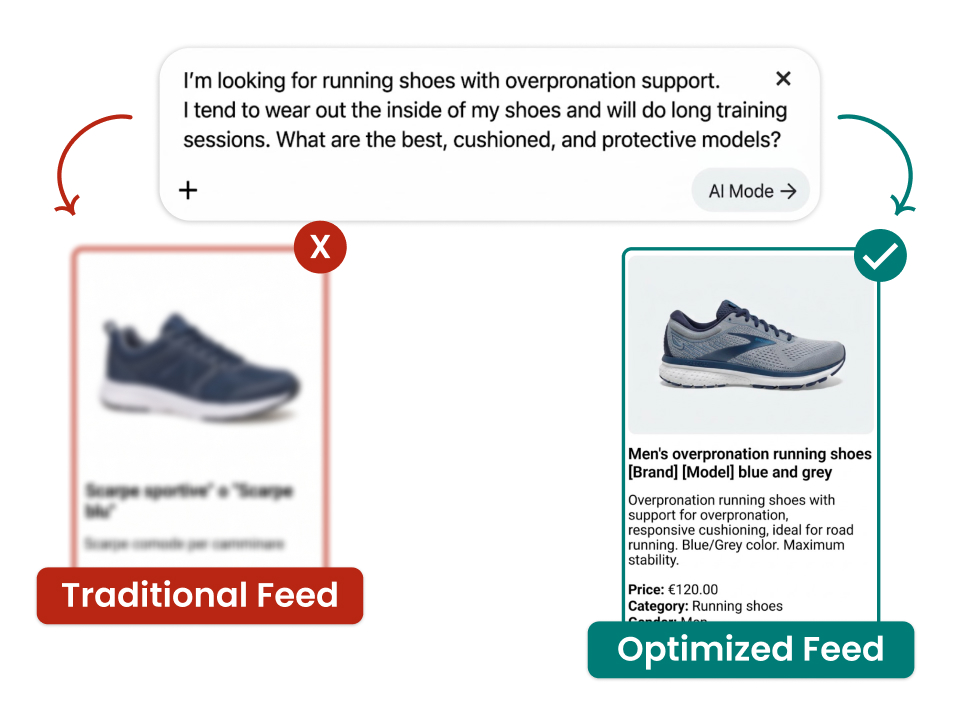
To address these needs, Google introduced Conversational Attributes to Merchant Center specifications, optional attributes engineered specifically to clarify product nuances for conversational agents. While marked as “optional,” omitting these attributes effectively means a product remains in the database without ever being cited by the AI. Google’s own documentation noted that omitting these fields “almost certainly guarantees reduced visibility in AI-generated responses.” Therefore, while technically optional, skipping them is highly discouraged in practice.
- native_commerce (checkout_eligibility): A boolean flag (true/false) enabling a “Buy Now” button directly within Google AI experiences (Gemini, AI Mode) for eligible merchants. Without this, products cannot be purchased natively within AI interfaces. (Note: Formatting depends on your source data format: TSV/CSV, XML, or Merchant API).
- question_and_answer: Structured FAQ pairs authored by manufacturers, merchants, or customers covering real-world usage details, fit guidance, or accessory compatibility. Example value: “Does it have a headphone jack?”:”This model does not include a headphone jack.”; “Does it support Bluetooth?”:”Yes, it fully supports Bluetooth 6.0.”
- document_link: Accepts up to 5 direct URLs pointing to official PDF files (user manuals, technical spec sheets, assembly instructions, safety certifications), allowing agents to analyze original documentation directly. Example value: [https://example.com/manual.pdf]
- related_product: Defines logical relationships between catalog items using precise taxonomies (required_part, accessory, often_bought_with, substitute), allowing agents to build complete, multi-item carts in a single prompt session. Example value: required_part:id:AZ7B, accessory:gtin:811571013579
- variant_option & item_group_title: Explicitly maps complex product variant combinations (e.g., shoe width, memory capacity, finish type). Example value: Shoe width:narrow,size:8
- popularity_rank: A percentile score (0–100) indicating an item’s relative popularity within a merchant’s inventory, providing an objective signal for algorithmic recommendations. Example value: 95.5
Marketing teams often worry that editing primary feeds might disrupt active Performance Max or Google Shopping campaigns. To prevent operational risk, Google recommends using Supplemental Feeds. These allow you to attach conversational attributes and native checkout eligibility to existing Product IDs without altering your primary feed, eliminating catalog suspension risks and preserving campaign stability.
AI “Readiness” Assessment
To evaluate whether your catalog is ready for AI discovery and recommendation, several diagnostic tools and frameworks are emerging:
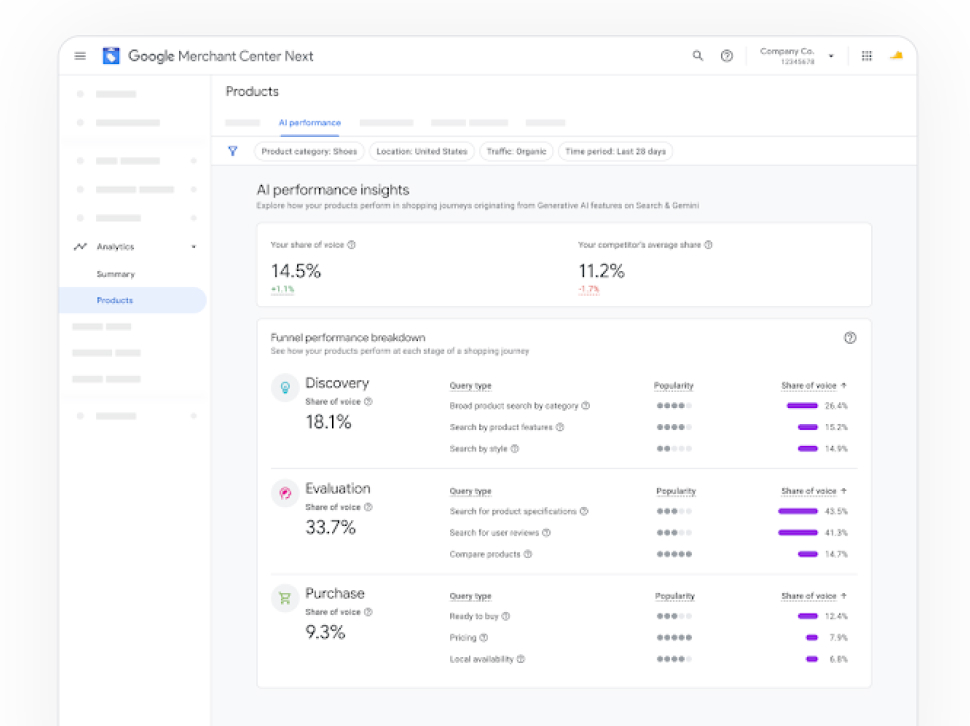
Google Merchant Center AI Performance Analysis (beta)
Tracks product discovery across AI Mode, SERP AI Overviews, and the Gemini app. Key reporting capabilities include:
- Share of voice: Benchmarks brand visibility in Google Search and Gemini AI experiences against similar brands.
- Shopping funnel performance: Provides visibility across funnel stages, including discovery, consideration, and purchase.
- Product term insights: Highlights trending conversational product terms, including share of voice per query.
- Product attributes insights: Identifies high-demand user attribute searches (e.g., color, style, material) and provides an attribute completeness score to surface missing data.
Crawlability & Robots.txt Audits
Verifies that major AI crawlers (e.g., Googlebot, StoreBot, ChatGPT-User) are not blocked from indexing product pages and image assets, a frequently overlooked bottleneck.
Technical Diagnostic Tools
Evaluates product detail page URLs to confirm that Schema.org microdata and crawler rules allow AI agents to parse and recommend items. Tools include the Shopify Agentic Readiness Tool and the Channable AI Product Search Audit.

Strategies and tools for feed data enrichment
Unlocking catalog visibility in an AI-centric ecosystem requires integrating these conversational data points at scale.
While Feed Management Platforms like Channable, DataFeedWatch, and Lengow offer automated data extraction and transformation tools, a core challenge remains: niche, contextual product data, the exact information AI agents prioritize, is often missing or costly to compile.
Overcoming this requires strategic shifts in how product data is sourced, structured, and managed:
- Direct data acquisition and internal mesh: Multi-brand retailers face higher standards during product onboarding and Digital Shelf/PIM management. Brand manufacturers will face pressure from retailers to deliver richer, more differentiated product data; failing to do so gives retailers an incentive to generate or scrape it elsewhere. This trend is reviving internal data meshing initiatives, connecting PIM, DAM, ERP, and CMS platforms to unlock siloed assets.
- Editorial licensing partnerships: In categories with strong enthusiast communities or established industry publications (tech, beauty, automotive), brands and retailers are partnering with publishers. Editors continually generate high-value data points through structured testing and technical reviews, leading to growing commercial licensing deals for enriched product data.
- User-Generated Content (UGC): UGC is a powerful way to supply data consumers and AI agents want, but that brands cannot state directly due to compliance, brand safety, or legal liability. Extracting and structuring details from customer Q&As and reviews converts crowdsourced feedback into “de-facto” authoritative attributes, especially for items not physically managed in-house.
Enabling native agentic checkout
The final hurdle in implementing agentic commerce is handling the transactional checkout flow.
First, merchants retain complete control: the brand remains the Merchant of Record (MoR), handling customer relationships, pricing strategies, fulfillment, customer service, and returns directly.
For direct in-interface purchasing (such as inside Gemini or Google Search AI Mode), technical standardization via UCP requires integration with Google Pay.
For an AI agent to execute a purchase autonomously, it needs instant access to a valid payment method and saved shipping address. Google Wallet and Google Pay act as the secure vault for these credentials. Rather than requiring users to complete traditional checkout forms, which breaks AI automation, Google Pay enables the agent to complete the transaction seamlessly in the background.
Security remains central to delegated purchasing. Google Pay never passes raw credit card details to the ecommerce server; instead, it transmits an encrypted, single-use token that the merchant’s Payment Service Provider (PSP) decodes. This protects consumers from fraud while removing the risk of sending unencrypted financial data through conversational interfaces.
INSIGHT REPORT
AI Evolution for Fashion Luxury
Is your brand ready?
CASE STUDY
Santoni
Digital BI to power up reporting efficiency