10 SEPTEMBER 2026
ChatGPT Ads: How to structure an ad campaign in the era of generative AI
The introduction of ads within ChatGPT via OpenAI’s dashboard represents one of the most anticipated and game-changing developments in the digital advertising landscape. Previously available in only a few select markets, the platform recently expanded to 31 European countries, unlocking new ways to engage users—this time directly within their conversations with LLMs.
We had the opportunity to preview and test this platform for several of our Fashion clients, targeting campaigns in the US market. This allowed us to immediately explore an entirely new ecosystem poised for rapid growth in the coming months.

Pre-launch tips & tricks: GEO synergy and AI-assisted targeting
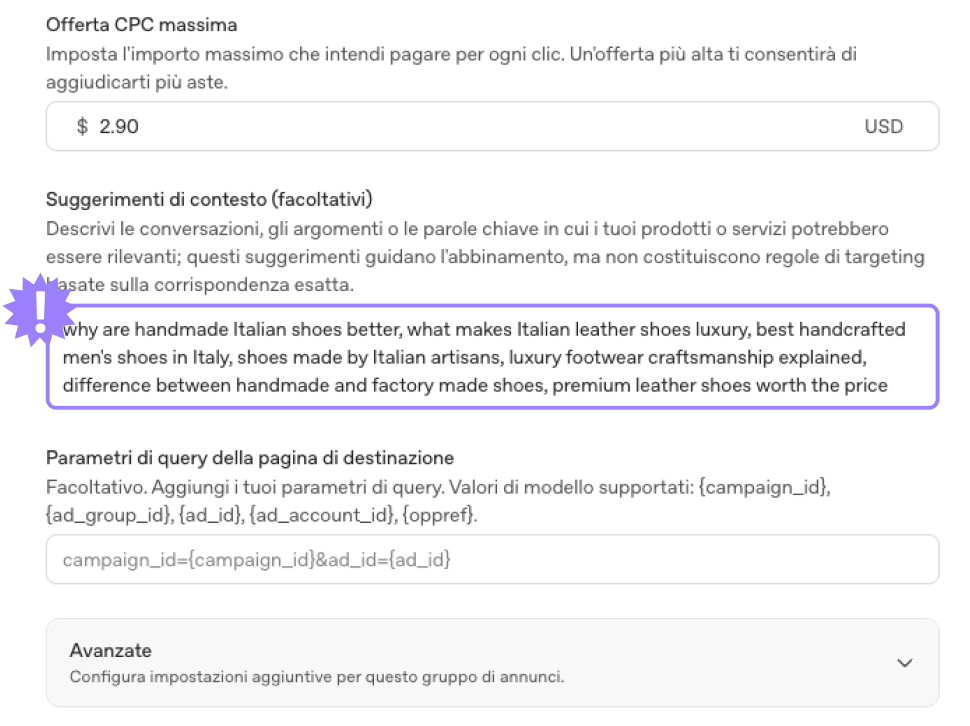
The first major difference compared to traditional advertising platforms lies in ChatGPT Ads’ targeting model. Unlike standard exact-match keyword targeting, OpenAI utilizes “Context Suggestions.” This is a text field where you describe the conversations, topics, or keywords where products might be relevant, relying on semantic matching rather than rigid, hardcoded rules.
To overcome the initial lack of historical data, we implemented a few key strategies:
- GEO Team support: We collaborated closely with Storeis’ GEO (Generative Engine Optimization) team, who were already tracking the most relevant and frequent brand-related prompts. This provided a solid baseline.
- Using AI to train AI: We leveraged ChatGPT itself to generate recommendations for populating “context suggestions,” identifying top-performing prompts based on prospective target audiences.
We then set up targeting tests at the Ad Group level, experimenting with both specific user prompts (e.g., “Suggest elegant outfits for a summer event”) and broader target audience descriptions (e.g., “Reach US users interested in contemporary luxury handbags and premium designer accessories who appreciate modern Italian fashion. Prioritize users looking for quality craftsmanship, Italian design, and timeless yet fashion-forward styles.”).
Both approaches delivered similar performance trends, demonstrating that OpenAI’s algorithm can effectively interpret context regardless of the suggestion format.
The 3 phases of launching on ChatGPT Ads
1. Account and campaign setup: current limitations and opportunities
During the setup phase, the platform features a streamlined configuration that remains somewhat limited compared to established ad networks. Campaigns offer three main objectives: Clicks, Reach, and the recently introduced Conversions.
Currently, the platform supports:
- Text + Image campaigns
- Product Feed campaigns (uploadable exclusively via SFTP connection)
2. Launch and results: format comparison and the challenge with Meta
When comparing Image + Text campaigns against Product Feed/Product Card placements, the data showed stronger KPIs for Product Cards, yielding lower Costs Per Click and higher Click-Through Rates.
When benchmarked against other platforms running traffic-objective campaigns, our test results highlighted two fundamental dynamics:
- Higher CPC: As pre-announced by OpenAI itself, the Cost Per Click on this platform is significantly higher than traditional social media acquisition/traffic campaigns, though it aligns more closely with non-branded Search campaigns.
- Comparable session quality: Despite the higher cost, website traffic quality (measured by Average Session Duration and Bounce Rate) remains fully comparable to metrics seen on other channels.
Context is crucial here: major social advertising platforms benefit from accounts active for years and algorithms backed by deep historical data. In contrast, ChatGPT Ads operates as a brand-new, emerging ecosystem. Consequently, campaigns require learning time and sufficient volume for proper optimization.
However, given the high search intent inherent in conversational interactions, cost efficiency should steadily improve as the technology matures and ad accounts build historical data.
KPIs to monitor at this stage:
- CTR (Click-Through Rate)
- CPC (Cost Per Click)
- Session Quality (Average Duration, Bounce Rate)
3. Post-launch: analysis and “lessons learned”
As an early-stage platform, ongoing management and optimization revealed several limitations typical of a Beta ecosystem:
- Evolving approval and setup dynamics: Automated ad review systems still display rigidities. During testing, we encountered occasional friction during campaign validation and product feed processing.
- Lack of technical support: Dedicated account managers or customer support are not yet available, though we anticipate this will be added soon.
- Missing Search Terms report: OpenAI’s biggest area for improvement lies in search intent transparency. Currently, there is no visibility into the exact user prompts that triggered an ad. Without knowing the precise query, determining exact ad placement context remains challenging.
- Basic reporting: Internal dashboards are rudimentary. We recommend exporting raw platform data to build custom reporting dashboards.
Conclusion
Running campaigns on ChatGPT represents a novel touchpoint between brands, audiences, and AI.
As the system matures and introduces advanced features—most notably deeper analytics on search queries and contexts—ChatGPT Ads has the potential to become an essential strategic asset. This will allow brands to engage target audiences not only during passive discovery, but within active evaluation journeys inside a highly qualified, natively conversational environment.
REQUEST THE FULL REPORT
- Researches, strategic reports and white papers
- Case Studies
- Invitations to workshops, training events and webinars
- Job alerts and job opportunity notifications