8 OCTOBER 2026
How to prepare for the first “AI-Ready” Peak Season
The Peak & Holiday Season is a crucial turning point for the annual success of a B2C ecommerce business. However, tackling Q4 in 2026 requires a different approach than in the past. Search, discovery and conversion dynamics have been transformed by the widespread adoption of conversational agents. This is, in every sense, the first true “AI-ready peak season”.
Competing solely on discount percentages or increasing budgets as Black Friday approaches is no longer enough. Brands need to build an omnichannel strategy that is data-driven and flexible in execution, in order to capture demand that starts much earlier and develops through increasingly non-linear journeys. Here are some key aspects that can help define a practical methodology to properly prepare your advertising infrastructure.

- 1. The weight of Peak Season: data and shopping behaviour
Black Friday remains the most widespread and relevant promotional event in Europe: around 57% of consumers shop during this period*, surpassing any other sales event of the year.
However, limiting your strategy to the final weeks of November is a mistake: the decision-making process has significantly expanded over time. Looking at when shoppers start considering the most expensive item in their basket, more than 32% begin their research before September. A further 16% enter the consideration phase in September, and another 16% in October. Only 22% discover and purchase a product for the first time during the promotional peak.*
This is further compounded by the rise of “Fake Friday” (the Friday before Black Friday), which alone generates levels of interest close to the peak. Every product category, from apparel and consumer electronics to home & garden, experiences a simultaneous surge throughout Black Week, driving up advertising auction pressure and acquisition costs.
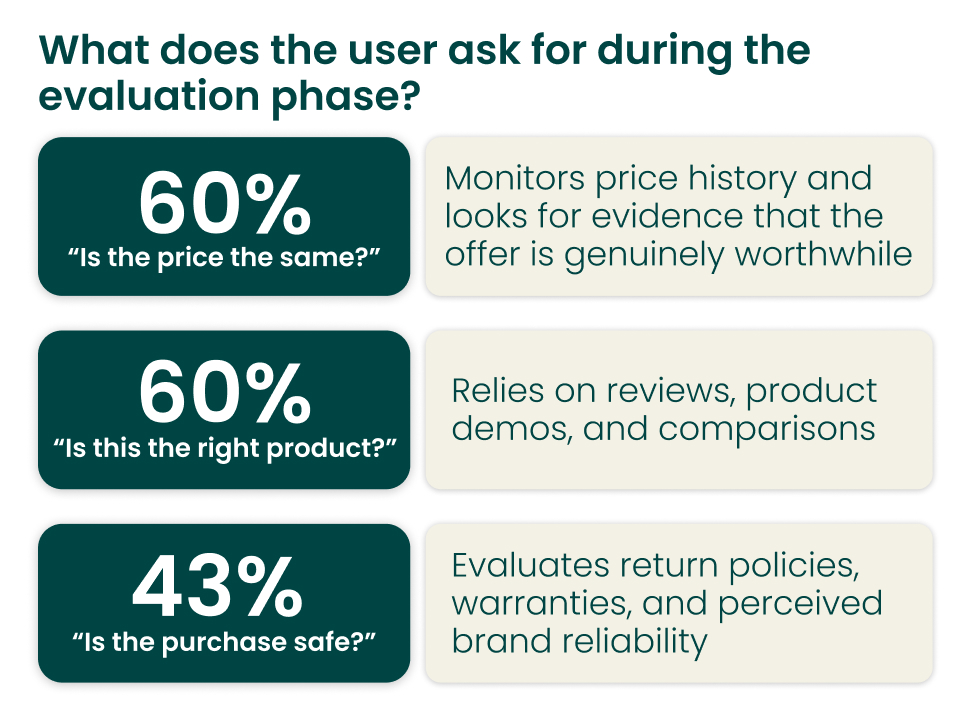
During this extended consideration phase, consumers seek to rationalise their purchase by answering three fundamental questions*:
- 60% ask themselves, “Is the price real?”: they monitor price history, set alerts and look for confirmation that the offer is genuinely worthwhile.
- 60% wonder, “Is this the right product?”: reviews, video demonstrations and comparisons become essential.
- 43% ask, “Is this purchase safe?”: flexible return policies, warranties, fast delivery and overall trust in the brand are decisive factors.
- 2. Conversational ads: a new ecosystem
The most disruptive development in 2026 is the structural integration of artificial intelligence into the shopping journey. Browsing is becoming increasingly conversational: instead of entering simple keywords, consumers formulate complex and highly specific queries.
A quick look at the current market share distribution among LLMs captures this new behaviour: ChatGPT and Gemini dominate the landscape, with a combined market share of over 65%. And although 31% of users say they still do not consciously use any LLM, the vast majority of digital interactions are now AI-assisted.
For ecommerce businesses, this means taking ownership of new interactive placements. We are already successfully testing platforms such as OpenAI Ads, recently made available in Europe, which allow brands to place their products within relevant conversations, reaching users precisely as they actively explore and compare their purchasing options.
On traditional search engines, advanced solutions such as Google Ads’ AI Max represent an opportunity to capture new conversational queries, which are becoming the new standard for search. These solutions make it possible to discover and intercept increasingly complex and latent search intent, moving beyond the rigidity of keywords. Adopting AI-powered campaigns can contribute to significant increases, estimated at around 27% on average according to Google’s internal data, in conversion volumes, while maintaining cost efficiency.
- 3. Tactical roadmap: methodology and multichannel actions
Click seasonality is becoming more unpredictable than ever, with very different traffic peaks across countries. The strategy should shift from simply acquiring new customers towards audience building, margin protection and infrastructure preparation, while avoiding fragmentation and adopting a multi-phase planning approach.
Phase 1: Setup (September – October)
During this period, it is important to nurture your audience ahead of the actual peak while addressing any technical issues across your ecosystem.
A common example is poor feed and product data health. Using high-resolution images and ensuring accurate descriptions and GTINs are basic requirements that are often overlooked. However, implementing simple solutions such as price annotations (“Sale Price”) and enabling promotions in Merchant Center can drive CTR increases of almost 8%*. It is also important to monitor catalogue diagnostics in Google Merchant Center or Meta Commerce Manager to prevent potential account or product blocks.
Another key area to focus on is ensuring that both the mobile browsing experience and your servers can handle sudden traffic spikes, guaranteeing continuity during the most critical days. From a UX perspective, clearly communicating delivery times and return policies helps protect margins and reduce cart abandonment.
Finally, since last-minute traffic is expensive and tends to convert poorly, these weeks should be used to build first-party audience segments, allowing you to fully leverage high-conversion channels when advertising costs become more competitive in November. For example, it may be useful to test:
- Early access launch: replace generic newsletter sign-ups with VIP lists offering early access to the most attractive deals. This can generate interest while simultaneously building an audience you can activate at the right time;
- Create Gift Guides in advance: publish dedicated gift pages from now on (optimised for SEO / GEO) to capture early exploratory traffic and build retargeting pools.
Phase 2: Activate (October – November)
This is the time when search volumes start to surge, making it crucial to consolidate media investment around your target audience.
Leveraging high-engagement platforms such as YouTube and integrating discovery-first channels such as TikTok and Meta is essential to generate awareness and stimulate latent demand, which can then be captured through more transactional formats.
TIP: On platforms such as TikTok and Meta, attention needs to be captured immediately: the hook (the first 3 seconds) determines an ad’s success. Working with native formats (e.g. Spark Ads) and incorporating User Generated Content helps keep communication authentic. As TikTok is a highly content-hungry environment, creative rotation needs to be fast to combat ad fatigue. Discover how we can help through our Content Strategy service.
For conversion-focused campaigns, budgets and targets should then be gradually adjusted during the month leading up to peak periods, allowing you to capture additional opportunities while maintaining efficiency targets.
Phase 3: Accelerate (November – December)
The period of peak conversion requires tactical responsiveness and no structural constraints.
For example, offering a flat 30% discount across the entire website can erode margins on orders that would have happened anyway. Segmenting offers based on customer history can help maximise AOV while protecting profitability.
Some ideas?
- For VIP and high-LTV customers, leverage early access to give them a reason to purchase ahead of the peak.
- For returning customers, consider tiered discounts (“Spend €100 and get 15% off”, “Spend €200 and get 25% off”, etc.)
- For one-time-buyers, leverage replenishment offers, bundles or recommendations based on their previous purchase to encourage repeat purchases and increase average basket value
- Finally, for new customers who have never purchased, a classic fixed introductory discount or an attractive free gift can be effective strategies.
One final recommendation, particularly when it comes to conversion campaigns during this phase, is not to constrain performance with overly restrictive daily budgets, as this can directly lead to missed incremental opportunities. Make sure there is sufficient headroom by setting budgets with a wide multiplier, even up to 4x your usual spend, to capture search peaks without triggering limited-by-budget status.
It is also crucial to manage bidding strategically, particularly when using a value-based approach (tROAS, or even better, Profit Bidding). For example, during the critical 48-hour window, proactively relaxing predefined targets or activating specific features such as “Promo Mode” can allow systems to compete more aggressively in auctions without permanently destabilising the algorithm’s learning curve.
Planning for Q5 (January): going beyond Cyber Monday
With Black Friday and Cyber Monday over, the focus on performance should not stop in December. The post-Christmas period offers advertising inventory with lower levels of competition and represents a strategic opportunity to monetise gift cards received as presents, drive winter sales and, above all, activate retention and win-back funnels for the substantial base of new customers acquired in the preceding weeks.
Source:
*Get Ready for Peak 2026_EMEA_ Tech Breakfast; Sept. 23rd, 2026
*TikTok Commerce Performance Marketing Playbook; Sept. 15th, 2026
ECOMMERCE TIP
Change Country
UX and SEO best practices for international ecommerce
ECOMMERCE TIP
GA4 Dashboard
The missing monitoring layer
CASE STUDY
La Sportiva
Scaling SEO content production with an AI & Human approach
INSIGHT REPORT
AI Evolution for Fashion Luxury
Is your brand ready?