16 OCTOBER 2026
AI and product search: Q1 2026 data
Our analysis of artificial intelligence’s impact on the ecommerce sector is updated with data from the first quarter of 2026. Although referral traffic from these platforms still represents a marginal share (often less than 1% of a site’s total traffic), monitoring it is useful for understanding the evolution of search habits and the sustainability of new models introduced by AI players.
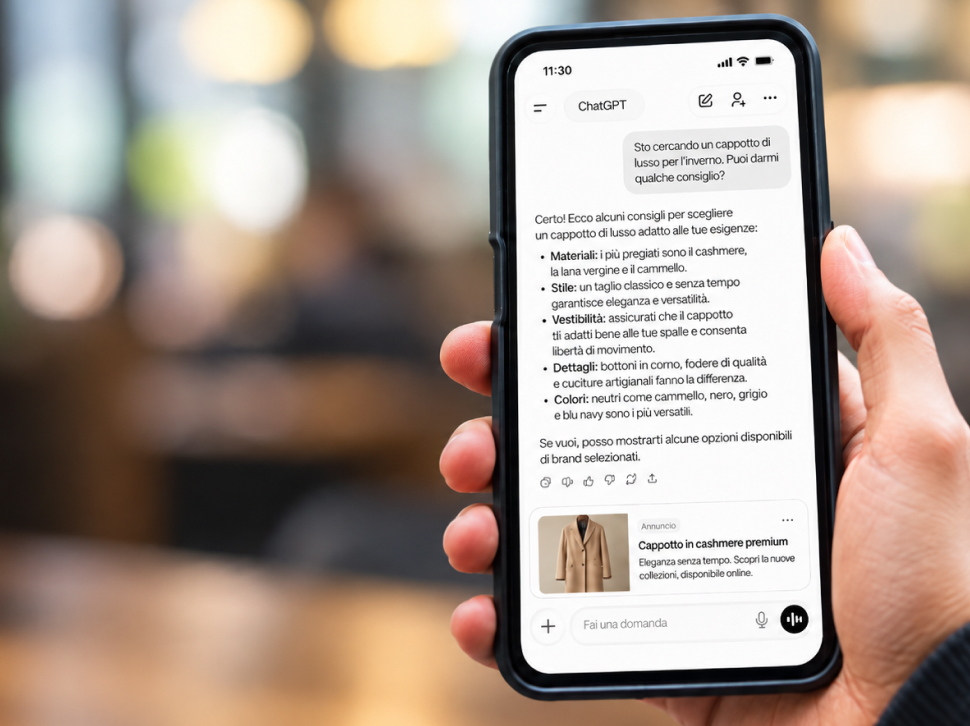
How AI assistants changed (Q1 2026)
The first quarter of 2026 marked a shift toward direct agentic automation and computational efficiency. The rollout of new low-cost reasoning models pushed major players to accelerate the move from purely conversational assistants to agents capable of taking action on the user’s behalf.
- ChatGPT and the “Operator” integration: In Q1 2026, OpenAI expanded Operator’s agentic features, letting the assistant interact directly with web interfaces to complete complex actions such as pre-filling checkout forms or automatically verifying shipping options. On the monetization side, ad tests on the “Go” plan and the free tier focused on placing sponsored products within responses to high purchase-intent queries.
- Google and Gemini (Shopping Graph and “Jarvis”): Google strengthened the integration between Gemini and its global Shopping Graph, introducing dynamic cards in AI results that aggregate reviews, local stock and real-time coupons. In parallel, autonomous browsing tests via Chrome advanced further, letting the AI guide the user all the way through the final step of the transaction.
- Perplexity and “Buy with Pro”: The platform expanded its merchant program, enabling direct integration of company catalogs and one-click purchase management right from the interface. “Sponsored Follow-up Questions” evolved into full sponsored comparison cards placed at the end of product searches.
- The impact of open-source models and inference costs: The sharp drop in compute costs driven by open-weight reasoning models (in the wake of architectures like DeepSeek-R1) let many ecommerce sites integrate their own proprietary conversational assistants, beginning to fragment the search experience beyond the major AI platforms alone.
- Claude and B2B/complex searches: Anthropic consolidated the use of advanced analysis features (“Computer Use” and extended reasoning models), used mainly for considered purchases, high-technical-density research and B2B comparisons, while still maintaining more modest B2C referral volumes than its competitors.
In Q1 2026 the focus shifted from text processing to task execution: AI is becoming a genuine operational interface. The real effects on conversion rates remain to be seen, as these are still technologies in active testing.
Ecommerce industry impact (Q1 2026)
Q1 2026 data shows a reorganization of referral traffic volumes from AI tools, totaling 280,068 sessions. This is a -19.2% decline compared to the previous quarter (Q4 2025), largely tied to the usual post-seasonal drop-off following Black Friday and Christmas shopping. Year-over-year (vs. Q1 2025), the channel nonetheless maintains an expansionary trend, up +138.6%.
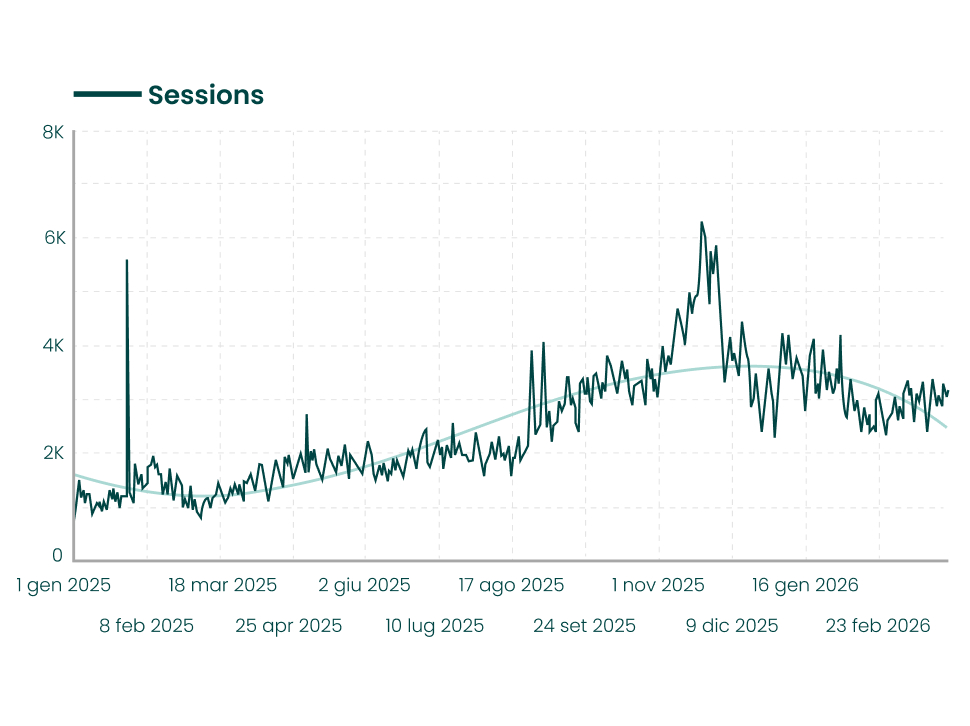
Despite the cyclical volume contraction, behavior and conversion indicators point to a further qualification of incoming traffic:
- Engagement: The Bounce Rate improved further, dropping to 23.2% (-3.8% vs. the previous 90 days and -22.4% year-over-year). Average Session Duration rose to 54 seconds (+6.1% vs. Q4).
- Conversione: The Add to Cart Rate (ATC) saw a significant increase, reaching 7.4% (+10.2% quarter-over-quarter and +90.3% vs. the same period in 2025).
With the promotional, comparison-heavy holiday phase behind it, Q1 2026 shows a user engaging with AI in a less exploratory and more targeted way. The drop in Bounce Rate to 23.2% and the parallel rise in ATC Rate to 7.4% indicate that traffic reaching the ecommerce site is highly pre-qualified, favoring the move toward checkout.
Top AI referral sources (Q1 2026)
Traffic source analysis for Q1 2026 shows a slight rebalancing of shares among the different AI assistants. While remaining by far the leading entry point, ChatGPT saw a modest decline, moving from 89% in Q4 2025 to 85.67% of total referral sessions today.
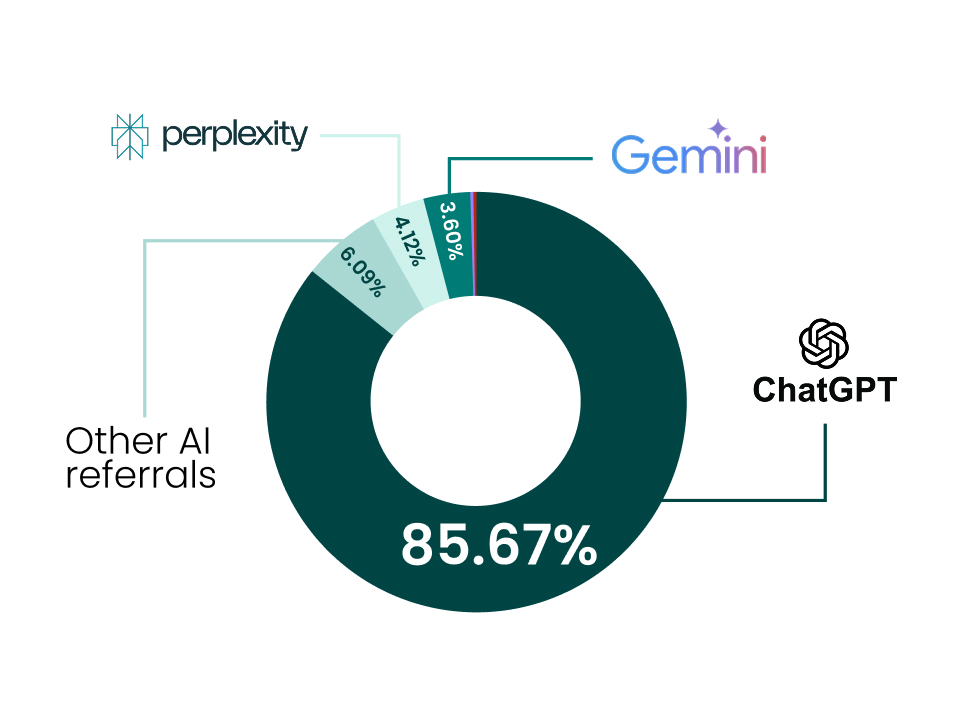
- Perplexity climbed to 4.12% of sessions (up from 3% the previous quarter), confirming itself as the second-largest direct traffic source.
- Gemini showed growth, reaching 3.60% (vs. 1% in Q4), likely driven by a greater presence of dynamic cards in AI overviews.
- Copilot saw a contraction in referral sessions, dropping to 0.12% (from 1% at year-end).
- The “Other AI referrals“ category rose to 6.09% (from 5% in Q4), suggesting a progressive fragmentation of search across smaller engines and assistants.
Tools geared toward specialist tasks such as Claude (0.36%) and Mistral (0.04%) continue to generate marginal shares of direct traffic to e-commerce platforms.
Q1 2026 revenue analysis
The breakdown of economic value generated by AI channels shows a realignment of revenue share toward the leading player, while also confirming some notable differences in efficiency between platforms:
- ChatGPT: Increased its share of total revenue, reaching 88.20% of overall earnings. The figure shows a monetization capacity slightly higher than its share of traffic (85.67% of sessions), pointing to a steady conversion propensity among its users.
- Other AI referrals: Account for 3.94% of the economic value generated, against a traffic share of 6.09%.
- Perplexity: Contributes 3.24% of total revenue, staying broadly in line with its session share (4.12%).
- Gemini: Stands at 2.18% of revenue, showing an economic conversion rate slightly lower than the traffic volume it generates (3.60%).
- Copilot: Remains the channel’s main anomaly. Despite generating only 0.12% of sessions, it generated 2.06% of total revenue, suggesting that visits driven by the Microsoft assistant tend to come with higher average order values or a stronger transactional intent.
- Claude and Mistral: Claude generates 0.30% of revenue, while Mistral is showing its first direct signs of monetization, though still at very low levels (0.09%).
Industries more affected by AI traffic (Q1 2026)
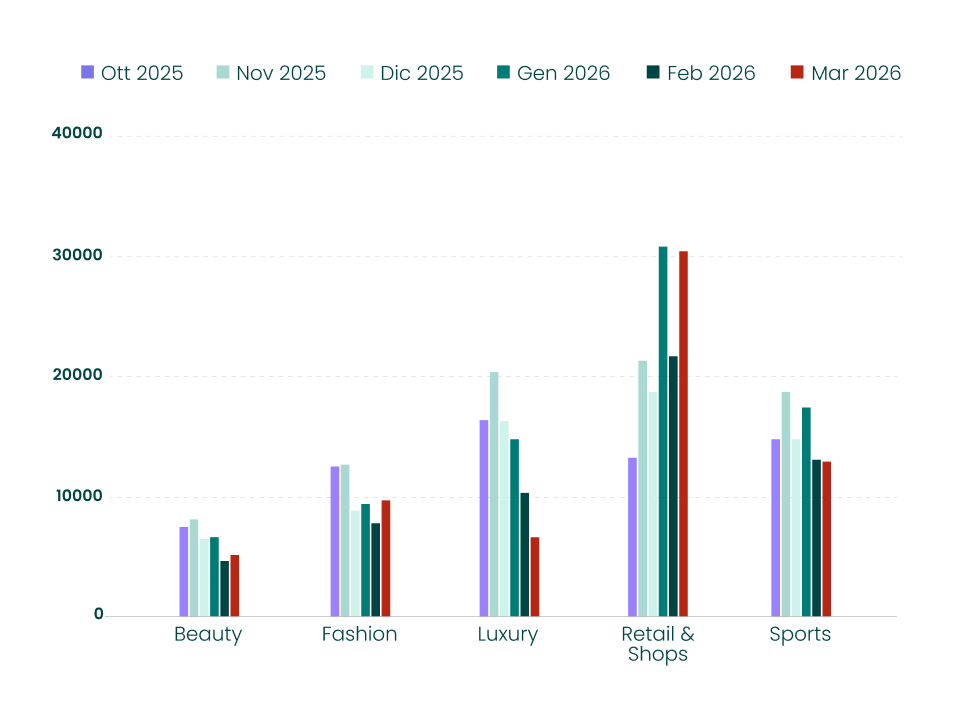
The sector breakdown of traffic in Q1 2026 shows a rebalancing of user searches following the year-end holiday peak.
The Retail & Shops segment consolidated its position as the top category, rising to 29.6% of total sessions (up from 21.8% in Q4 2025). The most significant shift concerns the recovery of the Hard Goods segment (consumer electronics), back up to 15.7% (from 7.2% the previous quarter), alongside a rise in Home & Design, which doubled its share to 12.1% (from 5.9%).
At the same time, there is a natural contraction in sectors more closely tied to gift-giving seasonality and year-end promotional shopping: Luxury dropped to 11.3% (after peaking at 21.7% in Q4) and Fashion settled at 9.6% (from 14.0%). Sports held a solid presence at 15.5% (a slight dip from 19.8%).
This pattern may suggest that, with seasonal interest in high-end apparel and gift items having eased, virtual assistant use has shifted back toward comparing durable goods and home items, while maintaining a strong consultation frequency for general retail.
Here is the traffic distribution detail for Q1 2026:
- Retail & Shops: 29.6% (Rising)
- Hard Goods: 15.7% (Recovering)
- Sports: 15.5% (Slight decline)
- Home & Design: 12.1% (Rising)
- Luxury: 11.3% (Post-holiday decline)
- Fashion: 9.6% (Decreasing)
- Beauty: 5.8% (Decreasing)
- Food: 0.3% (Stable)
- Kids: 0.1% (Stable)
What the data tells us (Q1 2026)
Q1 2026 data shows AI consolidating its presence among e-commerce acquisition channels.
With the holiday period behind it, and despite a cyclical session decline (-19.2% vs. Q4), the channel posted solid year-over-year growth (+138.6%) and a clear improvement in traffic quality.
The drop in Bounce Rate to 23.2% and the parallel rise in Add to Cart Rate to 7.4% suggest that the conversational assistant tends to absorb the exploratory phase, directing a more clearly intentioned user to the site.
At the same time, the recovery of segments like Hard Goods and Home & Design, along with the resilience of general retail, point to AI use extending to the search for durable goods and information-dense purchases.
For retailers, the 2026 challenge lies in staying on top of these conversational flows, making their data easily accessible to virtual assistants that are increasingly involved in the earliest stages of the purchase journey.